

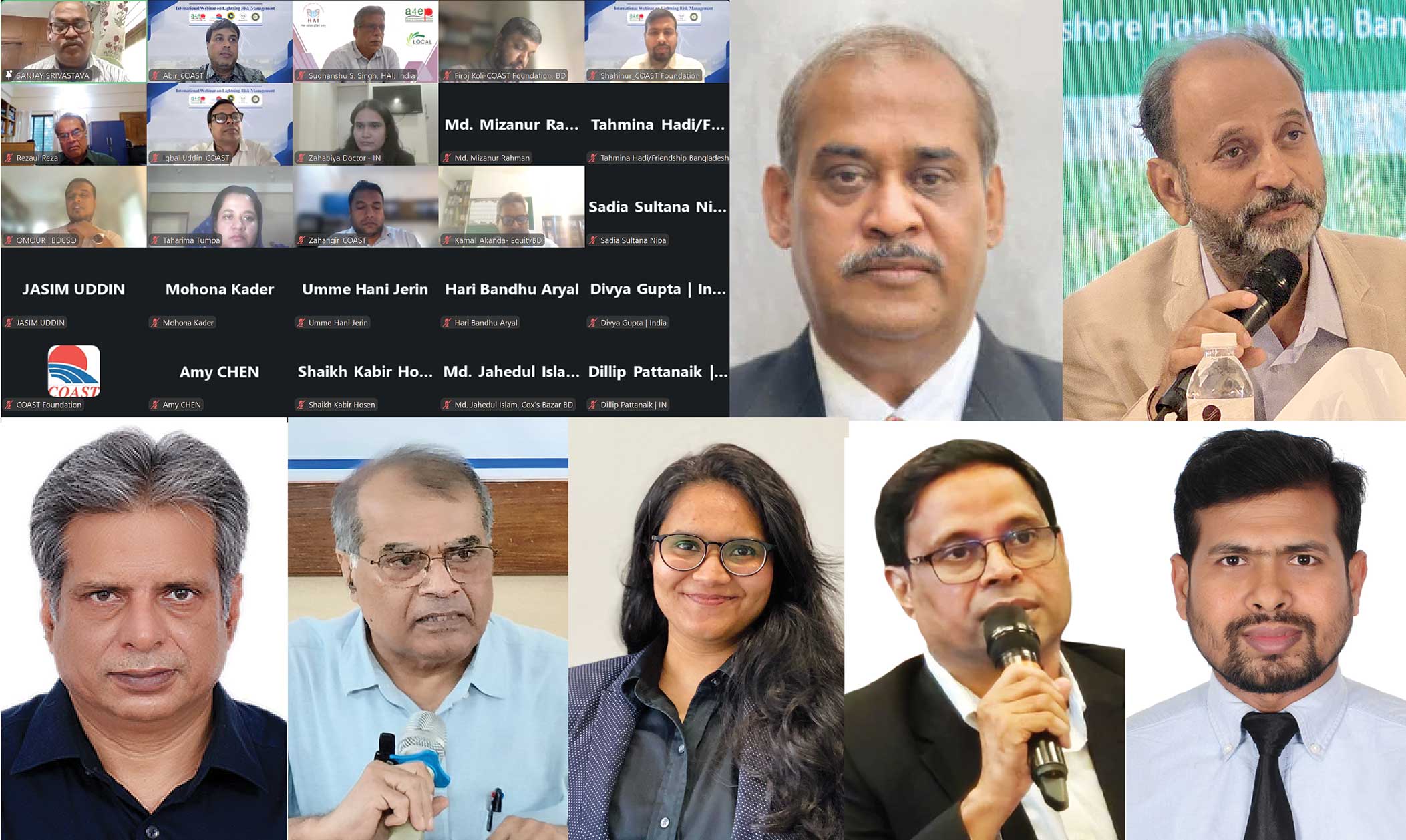
Dhaka, 14 May 2026: Civil society leaders, humanitarian and lightning experts from different South Asian countries have stressed the critical need to protect human lives from lightning strikes. Lightning is increasingly becoming a major risk, causing significant loss of lives every year. The incidence of lightning is rapidly increasing due to climate change, yet preparedness to address this risk is inadequate and is rarely incorporated into community-based disaster risk reduction programmes.
In response to this growing concern, Alliance for Empowering Partnership (A4EP), a network of local and national humanitarian actors in the Global South and a Grand Bargain Signatory, in collaboration with COAST Foundation from Bangladesh and National Disaster Management Authority (NDMA), Climate Resilient Observing Systems Promotion Council (CROP C) and Humanitarian Aid International (HAI) from India, jointly organised the international webinar titled Lightning Risk Management today. Disaster experts said lightning has emerged as one of the fastest-growing climate-related hazards in South Asia, with Bangladesh and Nepal experiencing the most severe increases in mortality and frequency. India also faces a significant surge in lightning incidents. They urged for introducing the Standard Operating Procedure (SOP), Early Warning Systems, community-based lightening risk reduction protocols, mass awareness, community participation and GO-NGO coordinated efforts for that.
Md. Iqbal Uddin from COAST Foundation welcomed the participants; Zahabiya Doctor from HAI moderated the webinar; Colonel (retd.) Sanjay Srivastava, the Chairman of the CROP-C and the Convener of the Lightning Resilient India Campaign, gave the keynote presentation, and Md. Shahinur Islam from COAST Foundation summarized the event recommendations and gave the vote of thanks to the participants. Distinguished speakers also included Sudhanshu S. Singh, Founder of HAI; Gawher Nayeem Wahra, Disaster Forum, Bangladesh; and Rezaul Karim Chowdhury, COAST Foundation, Bangladesh.
Sanjay Srivastava highlighted the importance of early action protocols and community safety measures to reduce lightning-related deaths. He noted that rising global temperatures are increasing lightning strikes, warning that a 1°C rise in temperature can increase lightning incidents by 12%. He emphasized the need for wider community awareness, tree plantation, safe shelters, localized action plans, Standing Operating Procedures (SoP), and stronger climate adaptation policies. He also stressed documenting indigenous knowledge and ensuring community participation in lightning risk reduction initiatives.
Sudhanshu S. Singh identified the lack of coordination among institutions and communities as a major challenge and called for stronger local, national, and global collaboration for knowledge sharing, policy development, and implementation of lightning safety protocols. Gawher Nayeem Wahra acknowledged Bangladesh government initiatives such as installing lightning arresters and tree plantation programs but stressed that community participation remains limited and must be strengthened for effective risk reduction. Rezaul Karim Chowdhury said the recent deaths of 14 people in eight districts of Bangladesh in a single day due to lightning strikes is alarming and called for coordinated action among government, NGOs, and communities to save lives. Iqbal Uddin warned that lightning is now claiming more lives annually than floods or cyclones in Bangladesh and urged the government to introduce a comprehensive Standing Operating Procedure (SoP) and national action plan on lightning risk management.
Participants from Nepal, Pakistan, Nigeria, India, Bangladesh, and China also took part and emphasized the importance of public awareness on the Do’s and Don’ts during lightning, identifying high-risk areas, and developing effective response and treatment protocols for lightning-affected people.
Please download Press release [Bangla] [English]
Newslink
 |
 |
 |
 |
 |
 |
 |
 |
 |
|
 |
 |
 |
 |
 |
 |